
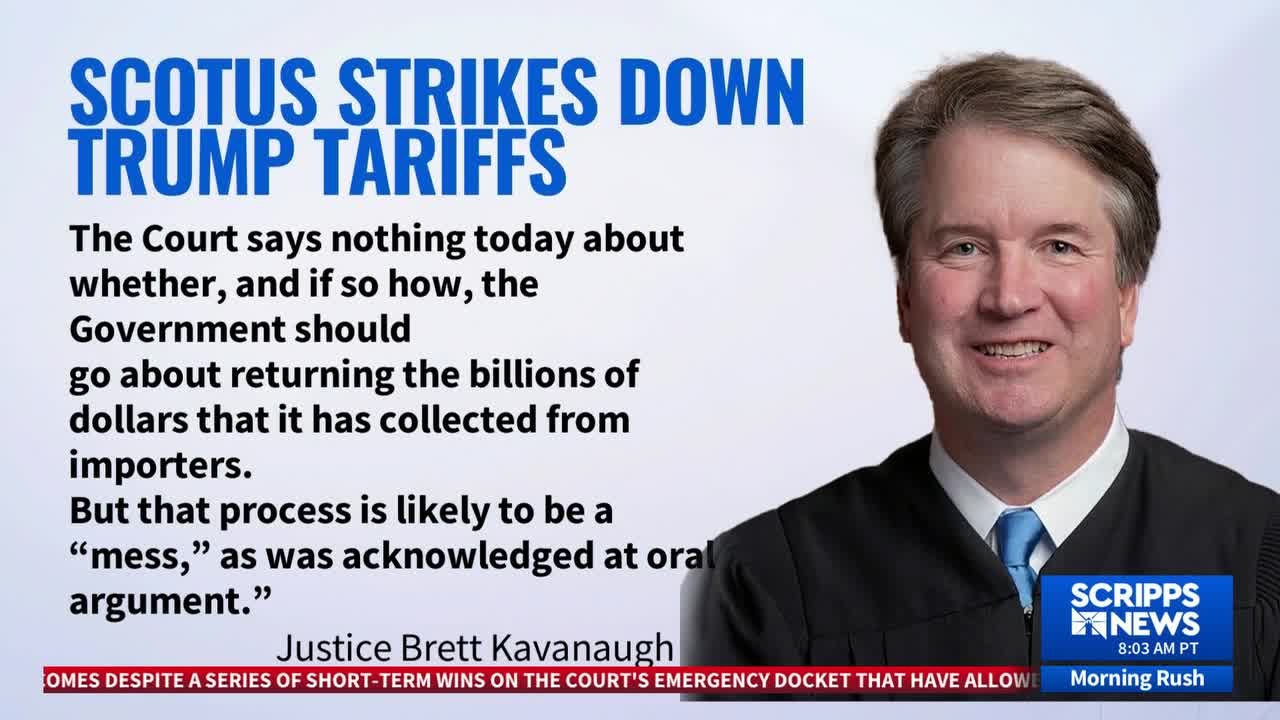


The U.S. Supreme Court ruled, 6-3, that the International Emergency Economic Powers Act does not give President Donald Trump the authority to impose tariffs, dealing a major blow to his trade agenda.
"I'm ashamed of certain members of the court, absolutely ashamed for not having the courage to do what's right for our country," Trump said during a press briefing on Friday.
Trump said he would impose tariffs under other laws. During the briefing, he announced plans to implement a 10% global tariff under Section 122 of the Trade Act of 1974. He also said national security tariffs under Section 232 and existing Section 301 tariffs would remain in place.
"Countries that have treated us badly will have to pay a price for treating us badly, and countries that have been good to us will be treated very well," he said.
RELATED STORY | With Trump's tariffs struck down, what happens to the billions collected?
Friday's order only blocks tariffs imposed under the emergency powers law. They were announced on “Liberation Day” on April 2, as well as tariffs enacted in February targeting imports from Canada, China and Mexico.
Chief Justice John Roberts wrote the majority opinion, joined by Justices Sonia Sotomayor, Elena Kagan, Neil Gorsuch, Amy Coney Barrett and Ketanji Brown Jackson, emphasizing that the power to impose tariffs rests with Congress.
Rick Woldenberg, CEO of Learning Resources and hand2mind, one of the plaintiffs in the case, said the ruling is “a powerful reaffirmation of the Rule of Law.”
However, Justices Clarence Thomas, Samuel Alito and Brett Kavanaugh dissented.
“The tariffs at issue here may or may not be wise policy. But as a matter of text, history, and precedent, they are clearly lawful,” Kavanaugh stated.
RELATED STORY | Study finds Americans shouldering 96% of Trump-era tariff costs
Trump has repeatedly said the tariffs were generating billions of dollars for the U.S. economy and could be used to pay down the national debt. He also floated the idea of sending checks to Americans funded by tariff revenue, though that never happened.
Many of Trump’s critics argued the tariffs functioned as a tax on Americans, as numerous companies said they would be forced to raise prices because of the added costs.
RELATED STORY | New analysis shows Trump's tariffs cost US households an average of $1,000 last year
Economists at the Penn-Wharton Budget Model estimated that more than $175 billion in U.S. tariff collections could be at risk of refund if the tariffs are ultimately unwound. The estimate was produced at the request of Reuters.
The ruling does not address whether businesses or consumers will be refunded for tariffs already paid. It also remains unclear whether Trump’s latest tariff moves will face new legal challenges. In his dissent, Justice Brett Kavanaugh wrote that unwinding the tariffs could be a “mess.”
Sen. Elizabeth Warren warned that large corporations could benefit more than consumers if refunds are issued.
"The Court has struck down these destructive tariffs, but there is no legal mechanism for consumers and many small businesses to recoup the money they have already paid," Warren said. "Instead, giant corporations with their armies of lawyers and lobbyists can sue for tariff refunds, then just pocket the money for themselves."
